Emotions
Book / Produced by partner of TOW
The Bible is an emotional book, and the church is an emotional community. Relationships have a highly emotive content. Teachers and preachers know that emotions are the power behind effective communication. Parenting involves the emotional education of children. In fact, there is no area of human life that excludes the powerful thrust of emotions. They travel with us wherever we go, and they affect whatever we do. It is not too much to say that without emotions we are detached and mechanical, subhuman and not as God intended.
The Good of Emotional Expression
The Christian faith is an emotional faith. Jesus Christ endured the cross "for the joy that was set before him" (Heb. 2:2). The apostle Paul was a man who was "sorrowful, yet always rejoicing." It was said of Jonathan Edwards that "he deeply savored the sweet sovereignty of God." C. S. Lewis insightfully remarked that the Lord "finds our desires not too strong but too weak."
In life we observe that interest energizes learning, creativity, and innovation; anger mobilizes energy for taking action against frustration, irritation or invasion; joy releases both celebration and stress as it it increases social exchange; shame assists us in discerning what is good and in making responsible choices; guilt motivates restoration of relationships and reparation of injuries; fear protects us by warning of imminent danger. The dysfunctions of each of these arise from exaggeration of the emotion and overload and overwhelming of the controls. But basically emotions are good.
Emotional expression serves several basic social functions. Our emotions signal the inner state of feeling; they request some response in thought or act by other participants; and they report when
the trigger of the emotion is some event, person, or situation in the context. In the expression of emotion we experience the intensity of both love and hate, acceptance and rejection, apathy and anger.
How We Feel About Our Feelings
Some people approach their emotions as being bad; those are the "stuffers." They treat their emotions as if they should never be expressed, repressing their own emotions and suppressing emotions in others. Such people say "I feel fine" or "I'm okay." But these are not really feelings. They are judgements about their feelings. Or they play one feeling most of the time (for example, anger or happiness) like a trombone with a stuck slide. The note may be pure, but there is more to a symphony than this.
Others approach their emotional states as if they had a right to express them in every conversation - they are the "gushers." These people feel that emotions are "who you really are." Bad temper for such people becomes a form of public littering in which others pick up the pieces. Unlike the stuffers, these people play all the emotions of the symphony, sometimes at the same time. Stuffers are afraid of gushers about as much as gushers are angry with stuffers.
There is a wondrous group of people who take responsibility for their feelings and see them as goal directed and purposeful. They are not dominated by their emotions, nor are they afraid of them. They see their emotions as useful. We will call these people the "emotional pragmatists."
Living as an emotional pragmatist may sound boring (to a gusher), but to a stuffer it must sound like heaven!
The Value of Emotions
Emotions serve four essential functions. First, they are an instrument of rationality. Gerhard Frost says that "the hungers of the heart outrun the reaches of the mind." Our emotions enable us to learn. They provide direction for what it is that we need to know. Emotions provide instant
rewards and punishment for truths held and values* broken.
Second, emotions are vital sensors to imbalance. They tell us if we are doing okay in social situations. Without emotions we would become like the leper who has no nerve endings and cannot know if he is breaking his leg or burning his arm. Emotions allow us the opportunity
to respond, to ask for forgiveness.
Third, emotions enable us to know if we have achieved genuine human contact with another. Without emotions we would be bionic automatons. Marital intimacy would become mere mating. Cherishing our children would be reduced to technological parenting, providing the correct punishment and reinforcement. Emotions answer the question, Have I made contact with this person?
Fourth, emotions give us the possibility of embracing another's experience. Without emotion we would not have the privilege to count another's experience as our own. As such, it is emotions that permit us to enter genuinely into human community and covenant.
What Are Emotions?
The word emotion originates in the Latin emuvare, meaning "to move ." We sometimes say, "That worship service moved me." That is, it motivated us in some way. We also say we are "moved to anger," as when we are cut off in traffic. The anger was in response to a frightening stimuli and resulted in a form of self-protection. As we understand emotions, we need to know that they are affective responses to some sort of stimuli-they occur in response to some idea, cue or influence.
There are thought to be a small number of primary emotions, of which all others are derivatives. Rene Descartes describes six primary emotions (what he calls "primitive emotions") that he believes encompass all human emotional responses: admiration, love, hate, desire, joy and sadness. Robert Plutchik sees the primary emotions as four bipolarities: destruction versus protection, incorporation versus rejection, reproduction versus deprivation and orientation versus exploration. However we define them, they are probably limited in number.
The developmental process of growth from infancy to adulthood begins with the emergence of the primary emotions of anxiety, basic fears, trust and mistrust, followed by anger, shame, self-doubt, guilt and inferiority, as well as joy, pride, self-confidence, curiosity, interest, grief, sadness, love, and forgiveness. As we move through the life stages, the periodic ascendance of particular emotions supports us during particular passages, transitions, losses, as well as empowers us to make discoveries and accomplish meaningful life projects. But where did emotions come from?
The Origin of Emotions
As early as 1872 in the first widely accepted work on expressive emotions, Charles Darwin argued that certain emotional expressions are innate and universal. These fundamental emotions, which
are recognized and labeled similarly across cultures, have been researched in multiple studies and include interest, joy, surprise, anger, sadness, disgust, contempt, fear and shame. Although the
interpersonal meanings of these vary from one cultural context to another, the basic spectrum of emotional possibilities is similar among humans of every group. While this describes emotions common to humankind, we can account for emotions by considering the intention of the Creator.
In our original creation we were "naked and . . . felt no shame" (Gen 2:25). Our creation emotions include trust, joy, and and love. We have these wonderful emotions because we are human beings created in the image of God. Through these feeling we express our full humanity and godlikeness. They are the emotions of worship. John Piper in his book Desiring God: Meditations of a Christian Hedonist begins with the statement "This is a serious book about being happy in God." He argues that the "chief end of man is to glorify God and enjoy him forever" (p. 14). God is an experiencing Being and needs to be experienced in personal and feeling ways. So we approach God in trust, joy and love. We do this boldy and directly because as Hebrews 4:15-16 says, "We do not have a high priest who is unable to sympathize with our weaknesses, but we have one [Jesus] who has been tempted in every way, just as we are—yet was without sin. Let us then approach the throne of grace with confidence, so that we may receive mercy and find grace to help us in our time of need."
Our basic emotional needs as we grow are fundamentally related to healthy emotional expression. These needs include belonging; achievement or success; economic security; self-respect; freedom from fear; love and affection; freedom from feelings of guilt; understanding and being understood. As these basic needs are substantially met, especially in relation to God, we express trust, joy, and love.
Not all feelings however, are as wonderful as these. Some emotions are directly related to our sinful state. Genesis tells us Adam s experience after his rejection of God: "I was afraid, because I was naked; and I hid myself: (Gen 3:10 NRSV). The feelings associated with this behavior are shame, fear and guilt. Some feelings relate to the inevitable consequence of living in a fallen world and with the disfigurement of God's image in our lives—as described in Genesis 3:16-19. These feelings are sorrow, disappointment, grief, despair, frustration, depression, and anger.
Thinking and Feeling
To understand the naturalness of our emotions, we must also consider the difference between thinking and feeling and how the two are related. Virtually all research supports the conclusion that there are separate processes and systems for cognition (thinking) and emotion (feeling). There has been a long debate with some scholars supporting the primacy of emotion to feeling (in other words, the mind is a rational faculty that creates reasons for what the heart wants to do) and others supporting the prior existence of perceptions (cognitions) to emotions (in other words, inside every emotion there is a perception; in fact, emotions are simply the energy for experiencing and expressing our perceptions.) The current theories see the two as equal processes with distinct neural pathways that interact, influence, motivate, shape and direct each other.
The primacy of feeling in infancy and early childhood yields to the dominance of thinking in youth and adulthood, but both processes occur and control, trigger and interpret, the other. Some counseling approaches interrupt the cycle of thought and feeling by working with cognition;
others enter through the enhanced and clarified emotional world. Affective therapists employ ventilating, flooding, learning the language of feelings, developing new patterns of experiencing
and expressing these feelings; cognitive therapists utilize restructuring the cognitive programs of old self-instructions and learning new ways of perceiving, organizing, naming, thinking and controlling thought processes. Either process may be selected as a more appropriate point of entry in facilitating change. Both assume we have the responsibility to deal with our own feelings.
Responsibility for Feelings
The role of theology in relation to emotions is to assure us of the goodness of our emotional creation and to point us toward emotional wholeness as we claim the full range of human possibilities in work, play, worship, and relationships. Theology also helps account for the complexity of our emotional life by explaining what has gone wrong with our human life, including our emotions. Further Christian theology directs our emotional life to service beyond ourselves.The role of ethics lies in the guidance of appropriate expression of emotion.
In the original garden Adam and Eve tried to transfer their responsibility to each other and to God. The New Testament, however, states: ''When tempted, no one should say, 'God is tempting me.' For God cannot be tempted by evil, nor does he tempt anyone; but each one is tempted when, by his own evil desire, he is dragged away and enticed. Then, after desire has conceived, it gives birth to sin; and sin, when it is full-grown, gives birth to death" (Jas 1:13-15). Also, in Ephesians 4:26 Paul says, "'In your anger do not sin': Do not let the sun go down while you are still angry."
By making us responsible, God confers a great compliment upon us. God says that we have what it takes to handle our most powerful emotional experiences. Indeed, if we do not take responsibility for our feelings, they can be corrupted. Love can degenerate into lechery, or joy, when not taken responsibility for, can degenerate into indolence and inactivity, as figure 1 indicates:
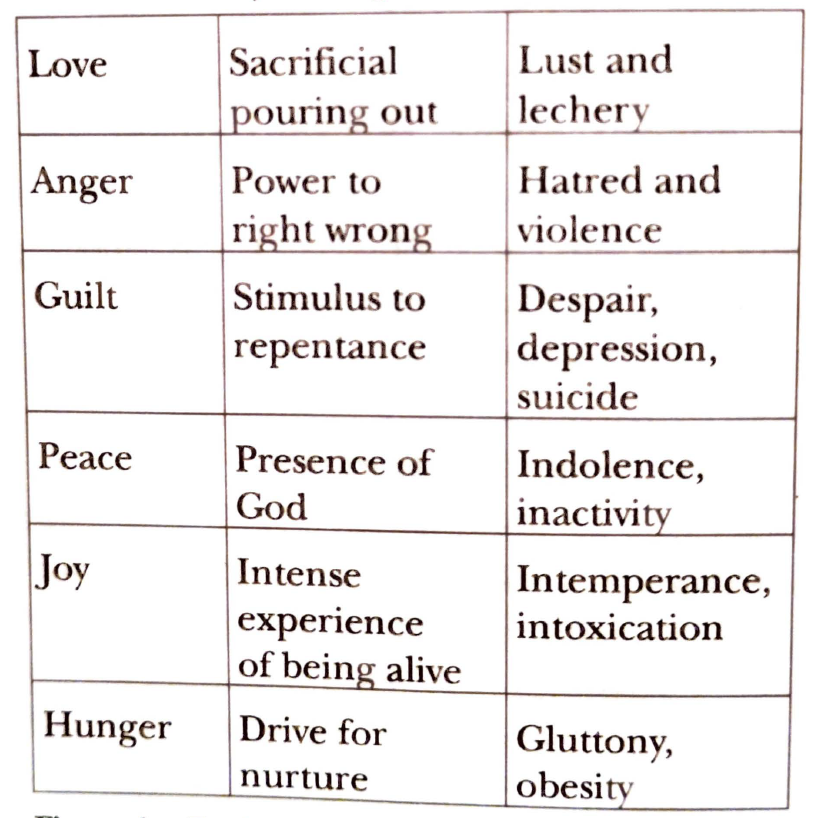
Control of Emotions
Notall emotions should be expressed. A reliable gauge of maturity is whether an individual knows what emotions are to be expressed and what ones should be limited or unexpressed. The ventilationist view of emotions is that unexpressed emotions corrupt the person's inner life.
This may not be always true. Expressing lust, anger or fear mav be a rehearsal of more dangerous expressions for future times. A child enraged should not be encouraged "to get it all out," for if he is, he will be "doing time" for his venting when he is an adult. How does one go about limiting and controlling unwanted but intrusive emotions?
First, we should recognize our emotional states. Unpleasant emotions such as sorrow,fear, anger, jealousy, shame, disgust, pain, confusion and emptiness need to be acknowledged. Many people do not even know they are angry or happy. This comes as a surprise when they get "in touch" with their feelings. As well, some people convert their feelings into experiences that they consider to be more desirable. When they are afraid, they may withdraw into depression. So, the first stage is to accept that there are uncomfortable emotions that are causing some upset.
Second, we should anticipate events so that we can avoid situations that are likely to produce undesirable emotional stress or approach the situations differently. We should determine the time and place to challenge our emotions. This stage of anticipation gives the person freedom to choose.
Third, we should care for our physical condition. An exhausted business executive confronting his overstressed wife about their problems with money will have a less than wonderful evening. Maximal physical resources are required to deal with difficult emotions. Church leaders tell me that they are able to deal with the stresses and fears of their work when they regularly take a sabbath each week.
Fourth, we should exercise some restraint in the overt expression of undesirable emotional states. Expression can quickly lead to venting of the undesirable emotion.
Fifth, we should expend the undesirable emotion in some socially approved manner. Paul advises the angry person in Ephesians 4:28 to work rather than steal: "He who has been stealing must
steal no longer, but must work, doing something useful with his own hands, that he may have something to share with those in need." This is often called "relating in the opposite spirit" and is a reliable way of handling strong emotions as long as it does not become a technique to avoid all feelings.
Sixth, we can set a deadline for the solution of emotional problems. Bracketing problems is quite helpful. Mature individuals have the ability to postpone negative emotions until some decided
time later on. It is possible for everyone to limit the ongoing expression of emotions. Finally, we can avail ourselves of a transformative resource.
Worship as Emotional Healing
C. S. Lewis wrote that "worship is inner health made audible." This is true of the Christian filled by the Spirit who sings and makes melody in her heart. All worshipers, whatever their emotional makeup, have the same needs. The two most essential are the need to be accepted for who we are (approval) and the need to change to become who we can be (transformation). These seemingly opposing needs are both met in worship. The call to worship implies approval. To enter
God's courts with praise is different from entering the courts of an austere monarch who will judge and reject us. So we anticipate acceptance and approval. But we are also transformed.
Popular psychology says that we are what we eat; life makes clear that we become what we worship. We need to be very careful about whom or what we worship. We will become like the object of worship, both good and bad (Ps 115:8). To worship Christ is to become like him. Personalities and emotions do not change in worship; they become transfigured. The anger of an easily irritated person is transfigured into right advocacy. The kind of thing that makes Jesus
fashion a whip causes the choleric to petition politicians. The phlegmatic's passivity is transformed into empathic compassion. Gentleness is empowered through being transfigured. If through
Christ we may come to God just as we are, we also dare not go away just as we have come, even in our emotional life.
» See also: Anxiety
» See also: Depression
» See also: Grieving
» See also: Laughter
» See also: Love
» See also: Pleasure
» See also: Worship
References and Resources
D. Burn , Feeling Good: The New Mood Therapy (New York: Arbor House, 1976); J. Cook with S. Baldwin, A Few Things I've Learned Since I Knew It All (Dallas, Tex. : Word, 1989); L. Crabb, Inside Out (Colorado Springs: NavPress, 1988); J. MacMurray, Persons in Relation (London: Faber & Faber, 1961); J. MacMurray, Reason and Emotion (London: Faber & Faber, 1935); B. Narramore, No Condemnation: Rethinking Guilt Motivation in Counseling, Preaching and Parenting (Grand Rapids: Zondervan, 1984); S. Peck, Further Along the Road Less Traveled (New York: Simon & Schuster, 1993); J. Piper, Desiring God: Meditations of a Christian Hedonist (Portland, Ore.: Multnomah, 1986); C. Tavis, Anger: The Misunderstood Emotion (New York: Simon & Schuster, 1982); D. Viscott , The Language of Feelings (New York: Arbor House, 1976).
—David Augsburger and Paddy Ducklow





The authors Robert Banks and R. Paul Stevens have partnered with The Theology of Work Project to offer The Complete Book of Everyday Christianity in its entirety here. All rights reserved.
This resource was originally published in 1997, and the text has not been updated.